It's Not Just Smartphones That Improved in Night Imaging. Drones Did Too.
Blog
5 March 2026
It's Not Just Smartphones That Improved in Night Imaging. Drones Did Too.
The night photo on your phone in 2018 was a smear of noise. The one you took last week has clean shadows, readable detail and colour that holds together. That did not happen because the sensor got dramatically bigger. It happened because of what the phone does with the data.
The same shift ran through drone imaging. And in facade inspection it produced something more interesting than "we can now fly at night" — it produced cases where night is the better time to fly.
What actually changed
Larger sensors on flyable airframes. Inspection drones now routinely carry 1-inch and larger sensors, with some professional platforms using micro four-thirds and full-frame payloads. Bigger photosites gather more light per pixel, and the signal-to-noise advantage at high ISO is substantial.
Back-illuminated stacked designs. Moving the wiring behind the photodiode layer increases the light-gathering area of each pixel. This is the same architectural change that transformed smartphone cameras, applied to aerial payloads.
Computational imaging. Multi-frame stacking, motion-compensated alignment and machine-learning noise reduction do most of the heavy lifting. Instead of one long exposure — impossible from a moving aircraft — the camera takes many short exposures and aligns them computationally. Noise is random and averages out; detail is consistent and survives.
Better stabilisation. Three-axis gimbals with improved IMUs hold the sensor steady enough that longer per-frame exposures remain usable from a hovering platform.
Thermal payloads that got affordable. Uncooled microbolometer resolution has climbed while price has fallen. A radiometric thermal camera that once required a dedicated aircraft now fits on a mid-range inspection drone.
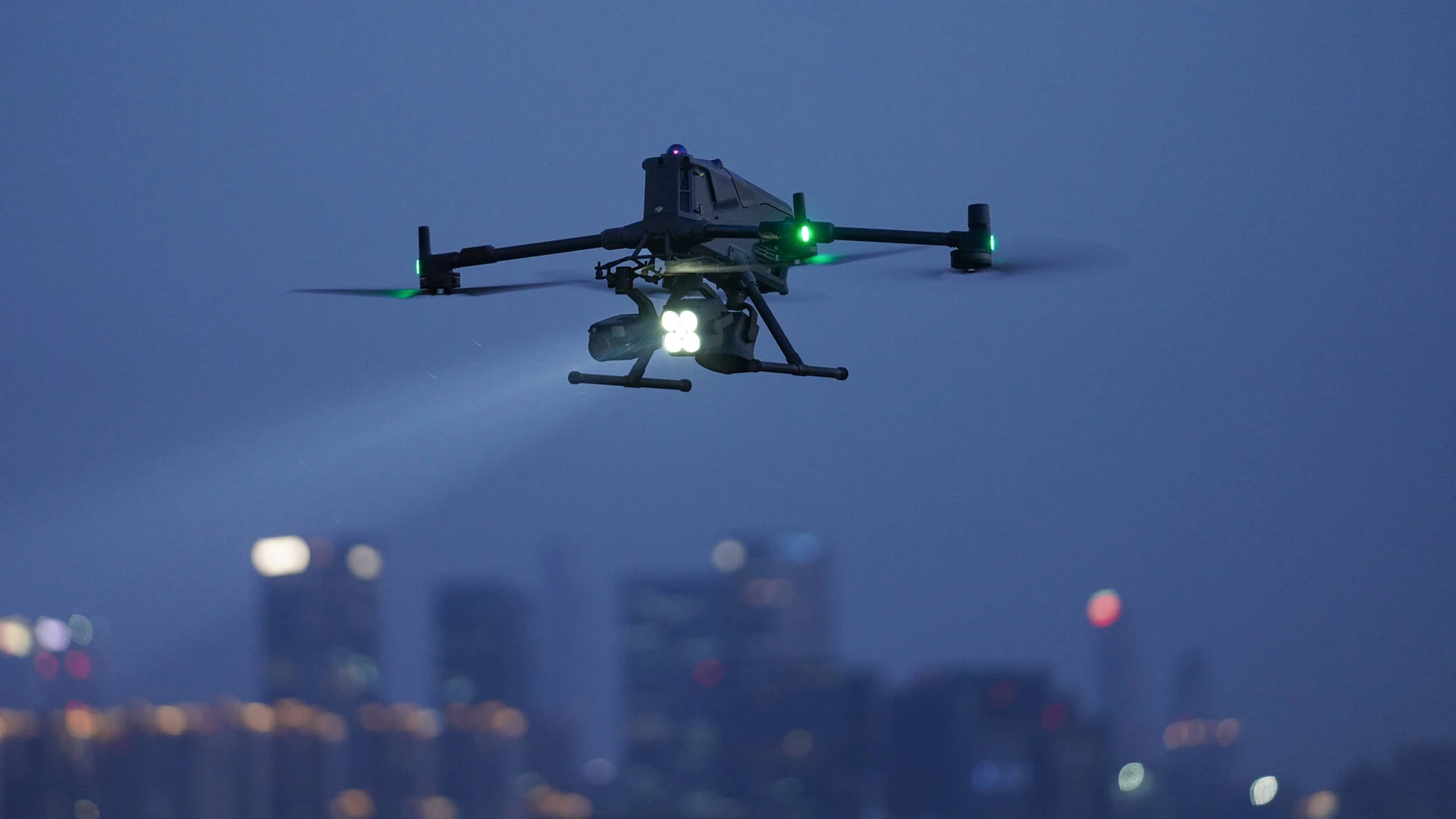
Integrated illumination. High-output LED arrays designed for aerial use let the drone light what it is photographing, at a controlled and known distance.
Why you would want to inspect at night
This is the part people miss. Night operation isn't a workaround for daytime constraints — for several defect types it is diagnostically superior.
Thermal imaging works better after sunset
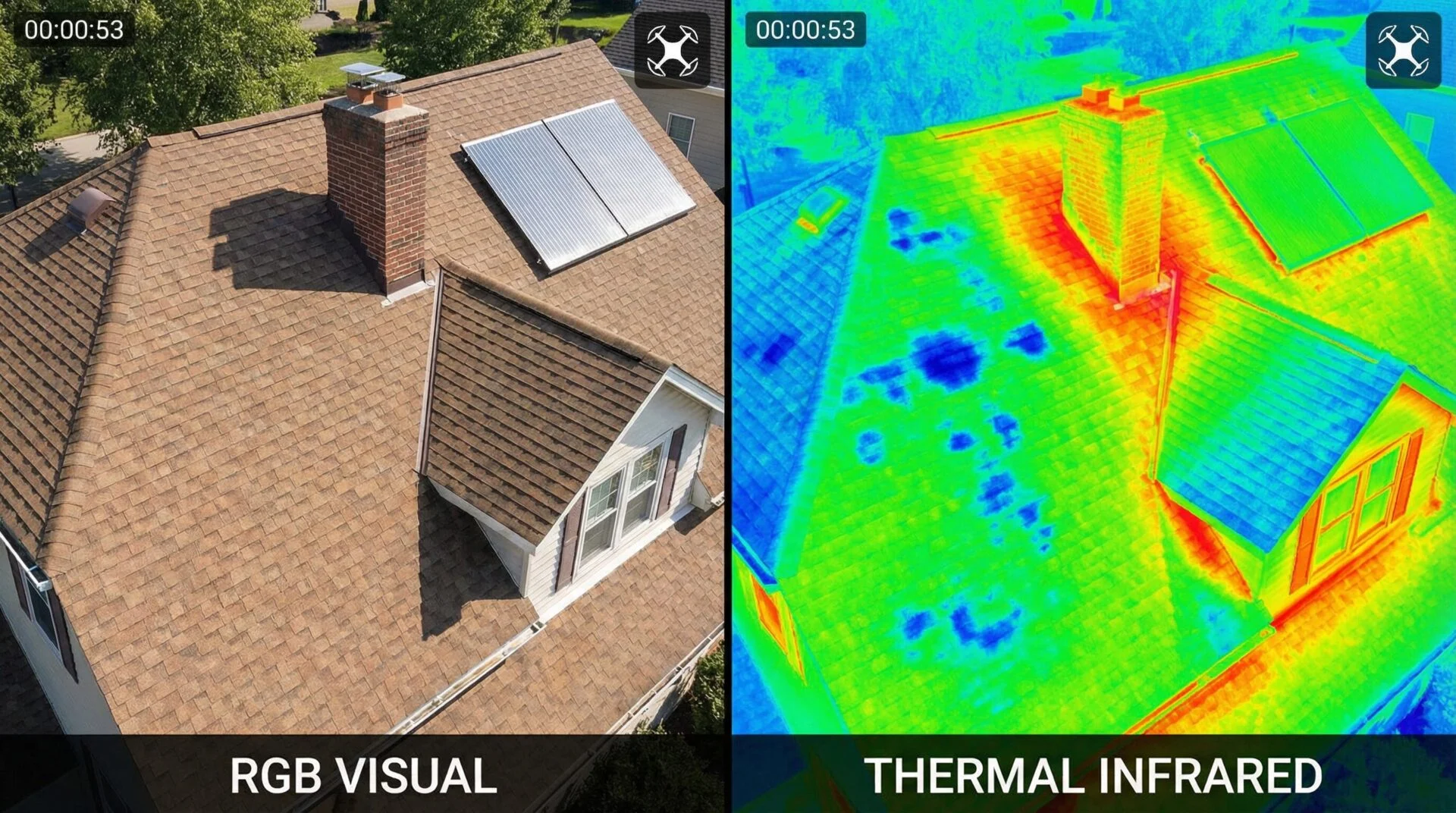
Thermography detects defects by detecting temperature differences. Those differences appear when a facade is heating or cooling unevenly.
During the day, solar loading dominates everything. A west elevation at 3pm is uniformly hot, and direct sun creates surface reflections that confuse thermal readings. The signal you want — a delaminated patch heating slightly faster than its surroundings — is buried under the sun.
At night, the facade sheds the day's heat. Debonded render and tile has an air gap behind it: less thermal mass, faster cooling. Well-bonded material stays warmer for longer because it is connected to the thermal mass of the structure behind. In the hours after sunset, that difference becomes clearly visible.
The same logic applies to moisture. Wet material holds heat longer than dry material and reads warm during the cooling phase.
In Singapore's climate, where every elevation gets substantial solar loading and daytime temperatures are uniformly high, the post-sunset cooling window is often the cleanest thermal data you will get. (Background: visual vs thermal defect inspection.)
Water ingress shows itself when things cool
Evening cooling drives condensation and reveals thermal bridging. Air leakage around glazing perimeters and at panel joints becomes visible as the temperature differential between conditioned interior and cooling exterior grows.
Raking light finds surface deformation
A controlled light source at a shallow angle throws long shadows from anything that is not flat. Bulging render, lipped tiles, panel bowing and step-offs at joints — all of which flatten into invisibility under midday sun — stand out sharply under raking illumination. Photographers have used this for a century; it works just as well from a drone.
Lit facades and signage need to be assessed lit
Architectural lighting, signage and media facades cannot be evaluated during the day. Failed fixtures, colour inconsistency, dead pixel blocks and uneven wash are night-only findings.
Operational reasons that still matter
Less pedestrian traffic under the flight path. Empty carparks for take-off and landing. No interference with business operations. Cooler, often calmer air. For a busy retail or commercial building, night operation may be the only way to work without disruption.
The constraints — and they are real
Regulatory. Night operations are treated as a distinct risk category under Singapore's drone regulations. Additional permit conditions typically apply, covering lighting on the aircraft, visual line of sight arrangements, and operator qualification. Expect more scrutiny and more lead time than a daytime application. This is a matter for the operator's permit application, not something a building owner should assume is automatic.
Visual line of sight. Maintaining meaningful visual contact with an aircraft in darkness requires strobe lighting on the airframe, additional observers, and conservative operating distances.
Obstacle detection degrades. Vision-based sensing systems that avoid obstacles by day are far less capable in low light. Wires, antennas, cables and thin structures are the specific hazard. Pre-flight survey in daylight before a night operation is basic practice.
Visual detail is still better by day. For crack detection and general condition survey, daylight remains superior — see the detection limits of aerial imaging. Night imaging is good; daylight at the 0.15 cm/pixel resolution BCA requires for facade defect photographs is better, and easier to achieve.
Cost. Night work carries premium rates, longer permit timelines and more crew.
The sensible operating model
Do not choose between day and night. Sequence them.
Daylight visual survey for the primary condition record — cracking, spalling, sealant, corrosion, cladding condition. This is the compliance backbone under PFI, where the Competent Person conducts a full visual inspection of each elevation, supported by drones and scanning equipment.
Post-sunset thermal survey for subsurface anomalies — delamination, moisture, air leakage. The cooling window is the diagnostic window.
Raking-light pass where surface deformation is a concern, particularly on rendered and tiled facades.
Hands-on verification of what the thermal and raking passes flagged. The representative hands-on inspection of each elevation remains a requirement — and it is far more valuable when it is aimed at specific anomalies rather than convenient drop locations.
Where night flying fits your PFI
None of this changes your statutory obligations. BCA's Periodic Facade Inspection regime requires buildings over 20 years old and above 13 metres to be inspected every seven years by a Competent Person, covering a full visual inspection and a representative hands-on inspection of each elevation. Where drone building inspection is used for the visual stage, the UAS operator must be accredited, the CP must notify the Commissioner of Building Control of the UAS details, and the CP must personally review all imagery and readings.
Night thermal work sits alongside that as a diagnostic layer, not a substitute for it. Its value in a PFI context is targeting: a post-sunset thermal sweep tells the Competent Person which parts of which elevation deserve the hands-on sampling. The statutory scope stays identical; the sampling simply stops being arbitrary.
If you are planning night operations as part of a PFI cycle, raise it with your CP early. Permit conditions for night flying are stricter and lead times longer, and the schedule has to work backwards from your BCA deadline.
The bottom line
Night imaging on drones improved for the same reasons it improved on your phone: better sensors, and far better processing of what those sensors capture.
But the reason to fly a facade at night isn't that it's newly possible. It's that a facade shedding the day's heat tells you things about its hidden condition that it will not tell you at noon.
If your building has tiles, render or stone cladding, ask your inspection provider what time of day they plan to fly. If the answer is "whenever we can get the permit," you are getting pictures. If the answer involves the cooling curve, you are getting an inspection.